


What the Best Teams Know About Conversations That Everyone Else Ignores
Conversation intelligence best practices are the one thing the best teams share. They have nothing to do with strategy decks or quarterly reviews. Instead, they come down to what you do with the talk itself.
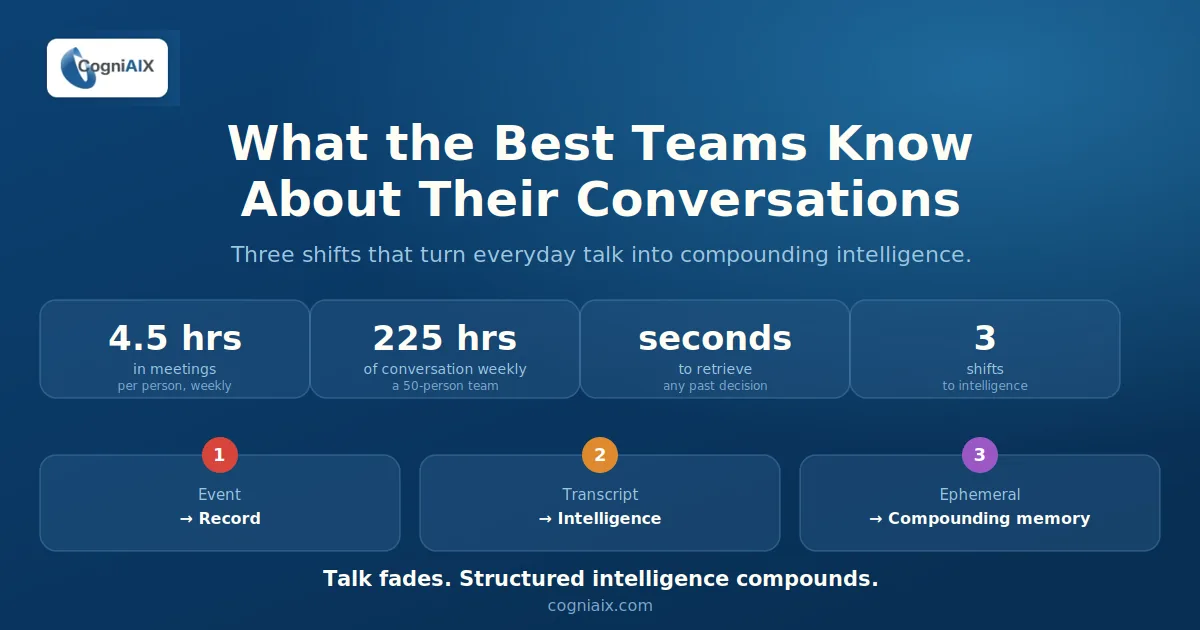
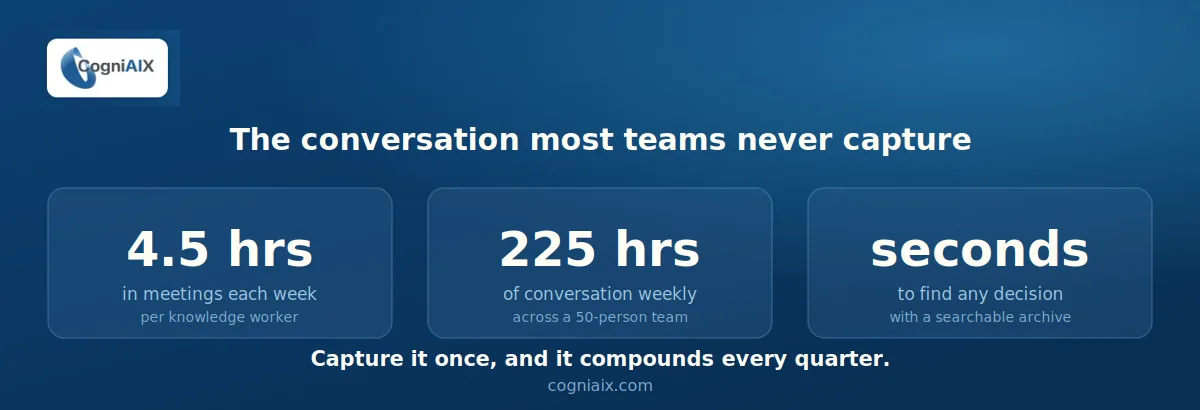
Here is a number that should give you pause. Knowledge workers spend about 4.5 hours a week in meetings (Microsoft Work Trend Index). Therefore, across a 50-person leadership team, that is 225 hours of conversation every week. Decisions get made. Commitments get given. Risks get raised. However, ask yourself one thing. What structured record do you have of any of it?
Teams that follow conversation intelligence best practices have a clear answer. Most teams do not. Moreover, that gap is not a small inefficiency. It is a real risk. Moreover, it grows every quarter.
The highest-leverage asset most teams never capture is the intelligence inside their own conversations.
The Invisible Asset Most Leaders Are Sitting On
Every important conversation creates something valuable. For example, a founder and a key hire, or a VP and their team. However, the value is not the talk itself. It is the decisions and commitments inside it.
Teams using AI insights from conversations treat those signals as data. As a result, they capture, index, and study them over time. In contrast, most teams treat them as throwaway — useful for the hour, then lost to memory.
Moreover, the difference is not a small detail. It decides how fast a team learns from its own patterns. It decides how reliably the team delivers. Furthermore, it decides how much knowledge survives when people leave — a classic organizational learning problem.
Three Shifts That Define How the Best Teams Operate
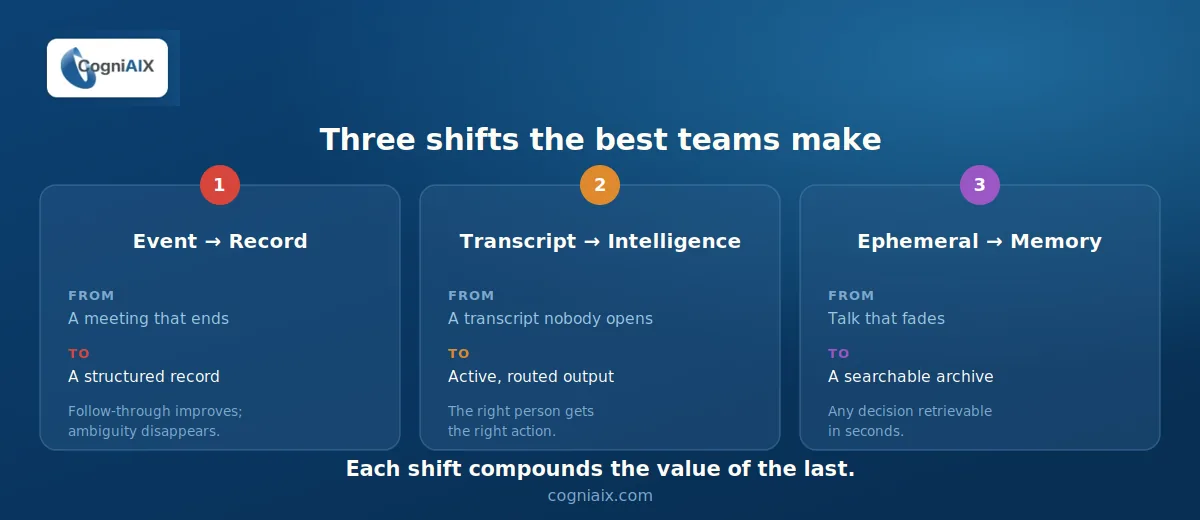
The teams furthest ahead have made three shifts. Moreover, the shifts are simple to describe. However, they are hard to make without the right tools. Here they are at a glance:
| Old default | The shift the best teams make | What it unlocks |
|---|---|---|
| Conversation as an event | Conversation as a structured record | Follow-through improves; ambiguity disappears |
| A passive transcript in a folder | Active intelligence, routed automatically | The right person gets the right action |
| Talk that fades from memory | A compounding, searchable archive | Any decision retrievable in seconds |
Shift 1: From Conversation as Event to Conversation as Record
In most teams, a meeting happens, it ends, and only what people remember survives. The best teams replace that default. Instead, every real talk becomes a record. It is built on its own, structured on capture, and ready at once.
Moreover, this shift has a measurable effect. As a result, when commitments are logged the moment they are made — with the owner and the deadline — follow-through improves. However, that is not because people work harder. It is because the ambiguity that protects non-delivery is gone.
Ambiguity is the main shield against accountability. Structured records remove it — with no culture change required.
Shift 2: From Passive Transcript to Active Intelligence
There is a version of recording meetings that helps no one. For example, a transcript nobody opens. However, that is not what the best teams do.
Real conversation data analytics pull out the decisions, commitments, and open questions. As a result, the output becomes active. It reaches the right person, attaches to the right project, and triggers the right follow-up. Moreover, no one has to direct it by hand. People deal only with the action: the decision to make, the promise to keep, the question to answer.
Shift 3: From Ephemeral Exchange to Compounding Institutional Memory
The biggest return is not what this does for one meeting. Instead, it is what it does across hundreds. For example, a conversation intelligence platform indexes every session. As a result, you get a searchable history of every decision. Moreover, you can retrieve any of it in seconds.
Therefore, "what did we decide about this product in March?" has a documented answer. "What was the last real talk about this account?" has a record. Moreover, that memory compounds. The longer you keep it, the more valuable it gets. Furthermore, the gap widens between teams that have it and teams still running on recall.
The Future-of-Work Implication Most Leaders Are Not Yet Acting On
Most talk about AI at work focuses on automation. For example, which tasks get replaced and which roles are at risk. However, the bigger implication is quieter and more durable.
AI does not just automate work. It structures the output of human talk. Moreover, it does this at a scale never possible before. As a result, AI insights from conversations do not replace the people in the room. Instead, they make sure what those people produce is captured in full. Furthermore, the decisions, commitments, and shared intelligence are structured automatically and kept accessible.
Moreover, that is a new capability, not an efficiency play. Therefore, teams that see this build a lasting edge that grows. However, teams that treat it as a "meeting tool" miss the point.
AI does not just automate work. It structures the output of human interaction at a scale that was never possible before.
People Also Ask — Conversation Intelligence Best Practices
What are conversation intelligence best practices for founders and executives?
The best conversation intelligence best practices treat every important conversation as structured data. For example, you can:
- Capture commitments on their own, with the owner and the deadline.
- Build a searchable history of every decision.
- Use conversation data analytics to track follow-through rates.
What AI insights from conversations are most valuable for leadership teams?
The most valuable AI insights from conversations for leaders include:
- Commitment follow-through rates across teams.
- Recurring topics that cause confusion.
- Patterns in how decisions get made versus how they get done.
- The gap between what was said and what gets done.
Moreover, no survey or dashboard can surface this as accurately.
How quickly do conversation intelligence best practices produce measurable results?
Most teams see output from the first captured session. For example, a structured summary replaces manual notes, action items get tracked, and a searchable record is ready in minutes. However, the compounding value — memory, pattern recognition, better execution — builds over weeks and months.
Does conversation intelligence apply outside of sales and customer-facing functions?
Yes, and often more so. For example, leadership, product, strategy, and operations all make big decisions in conversation. Moreover, they all face the same problem: turning talk into trackable action. Therefore, conversation intelligence best practices apply wherever decisions are made out loud.
What is the first practice to adopt?
Start with Shift 1. Treat every real meeting as a record, not an event. As a result, the moment you capture one consistently, the other two shifts get easier — because you have the raw material to interpret and the archive to index.
Applying Conversation Intelligence Best Practices at Scale
CogniAIX is built for teams that take this seriously. For example, it captures every meeting and detects commitments in context. Moreover, it writes structured summaries before the next session. As a result, it builds an encrypted, searchable archive.
Moreover, the platform applies these practices to the meetings you already run — without changing how they happen. As a result, the meeting ends and the output is already structured, distributed, and indexed. Therefore, work moves. That is the standard the best teams have already adopted.
Try CogniAIX free — capture your first meeting today. No credit card required, and your first structured summary lands in minutes.