

Follow-Up Failure: Why 71% of Meeting Action Items Never Get Done
AI insights from conversations turn spoken meetings into tracked work. However, most teams still lose 7 out of 10 action items because no system catches what gets said. So, decisions vanish, owners stay vague, and follow-up emails arrive too late to matter. Fortunately, AI insights from conversations fix this gap fast. Notably, they save hours of admin, give every task a clear owner, and route work to your tools automatically.
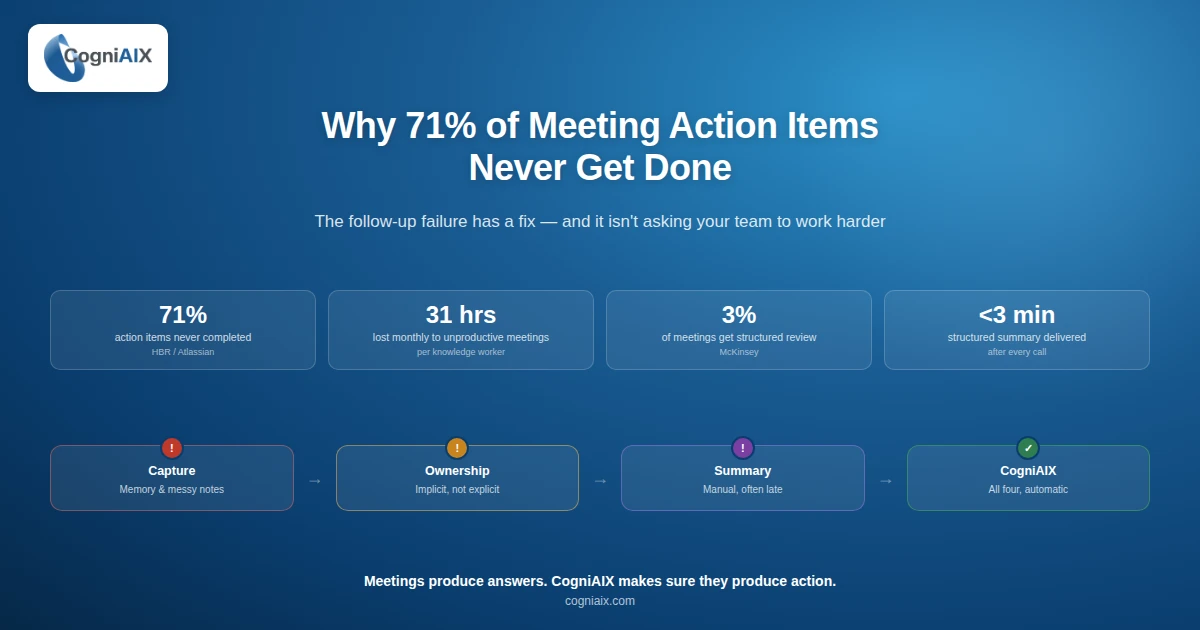
Moreover, the 71% number is not just one stat. Indeed, it is the result of several gaps stacking up. So, the cost shows up across every team:
- First, knowledge workers waste 31 hours per month in unproductive meetings, per Atlassian's State of Teams research.
- Second, more than 67% of meeting action items are dropped before completion, according to Harvard Business Review.
- Third, only 3% of work calls get any kind of follow-up review, McKinsey notes.
- Furthermore, the average worker spends 21.5 hours a week in meetings — half the work week — per Microsoft's Work Trend Index.
- Finally, industry data shows that fewer than 30% of action items get done when no system tracks them.
"The meeting happened. The work did not move. That is the problem CogniAIX was built to fix."
For example, picture 4:15 PM on a Wednesday. Specifically, you just wrapped a 50-minute product review with your remote team. Overall, eight people across three time zones joined. Indeed, the energy was good and the talk was sharp. So, four clear decisions were made and six tasks were called out by name.
However, by Friday, two of those tasks have vanished. Meanwhile, one went to the wrong person. Also, another got the wrong date. Therefore, the recap email sits in someone's drafts. Of course, nobody flags any of it — not until the next standup, when the talk starts over.
How AI Insights from Conversations Fix This Problem
Clearly, AI insights from conversations are not a "nice to have" feature. Instead, they are the system that catches what was said before it disappears. Notably, the tool grabs every promise, picks out what matters, and routes the right output to the right people. So, your team gains hours back and gets cleaner records of every call. Moreover, the breakdown that creates the 71% gap has four root causes. Notably, each one makes the next worse.
Failure 01: No capture at the source
Firstly, most meetings end with calls that live only in people's heads. Meanwhile, notes get taken by whoever volunteers, in whatever way they prefer. So, the bits that matter most — what was agreed, who owns it, by when — are the bits least likely to land in a useful form.
Therefore, without real-time AI insights from conversations, the record rests on human memory and manual work. Unfortunately, both fail under load. Indeed, research on recall shows that retention of unstructured talk drops sharply within a day. Notably, this pattern is known as the Ebbinghaus forgetting curve.
Failure 02: Ownership is implicit, not explicit
For instance, "we should get this reviewed before Thursday" is a wish, not a task. Although it sounds like an action item, it assigns nothing concrete.
Indeed, studies on team output show tasks with no named owner get done at a much lower rate than tasks tied to a person. So, the gap between "someone should" and "James will" is the gap between an idea and a result.
Clearly, named ownership is not red tape. Rather, it is the line between 71% failure and steady delivery. Fortunately, meeting follow-up AI catches who made the promise and assigns it on their own. So, your team gains clear accountability without extra effort.
Failure 03: The summary is a manual task
Typically, the summary gets written late, or not at all. After all, the person on the hook has the same meeting load as the rest. In other words, the summary does not vanish — it just lands too late to matter.
Furthermore, CogniAIX data shows that writing a post-meeting summary takes 45 to 60 minutes per person per week. So, that is roughly 4% of a full-time week spent rebuilding what was already said. Fortunately, AI insights from conversations eliminate that time entirely.
Failure 04: Notes are not built for action
Moreover, even when notes exist, they rarely drive action. Specifically, a wall of text needs to be read, parsed, and sorted. So, that work is enough to make most people put it off — especially with a full inbox and back-to-back calls.
Therefore, structure is not a style choice. Rather, it is the line between notes that get used and notes that get ignored. Clearly, the right format saves time and removes guesswork.
How CogniAIX Closes the Gap with AI Insights from Conversations
In short, CogniAIX grabs the call, reads context, and builds structured output automatically. Notably, the benefit is clear: your team saves hours, gains visibility, and ships work faster. Furthermore, the table below maps each failure point to what changes:
| Failure point | Current state | With CogniAIX |
|---|---|---|
| Decision capture | Memory, patchy notes | Real-time, speaker-tagged transcript |
| Ownership | Implicit or absent | Tagged by context, named by person |
| Summary | Manual — fights for time | Auto — sent before the next meeting |
| Note structure | Prose, not action-ready | Decisions / Actions / Open Questions |
| Task routing | Manual CRM or PM entry | Auto — to Jira or Asana |
| Archive | Static files, rarely searched | Encrypted, indexed, searchable in seconds |
Furthermore, CogniAIX does not match keywords to find tasks. Instead, it reads context — the gap between "I will send this by Thursday" and "we should think about this." Indeed, that gap is where AI insights from conversations get useful — not just typed talk, but tracked work. Notably, the platform hits 98.9% transcription accuracy in clean audio. So, summaries land within 2 to 3 minutes of the call ending.
The Same Meeting, Two Outcomes
Firstly, look at what happens without conversation analytics. Specifically, Thursday's call ends and four tasks live in the heads of six people. Then on Friday afternoon, the summary gets written half-done. Meanwhile, two items are missing and one sits with the wrong person. So, by Monday most of the work has not started.
However, with CogniAIX the same call plays out differently. Indeed, within three minutes a structured summary lands in six inboxes:
- First, 3 decisions, tagged and timestamped
- Second, 4 action items, each with a named owner and a date
- Third, 2 open questions flagged for review
Furthermore, tasks land in Asana on their own and the CRM record updates. So, by Monday the work is moving — because nobody had to guess who owned what. Clearly, the benefit is huge: fewer status meetings, faster delivery, and a team that trusts the record.
Who This Solves It For
Of course, the follow-up gap looks different by role. Indeed, each one feels the win in a clear way.
Firstly, remote team leads save the first ten minutes of each call by skipping the recap. Consequently, they lead the work instead of rebuilding last week.
Secondly, project managers get tasks tagged with dates and routed to their PM tool on their own. Therefore, the gap between meeting and tracking closes — and delivery speeds up.
Thirdly, HR and People Ops stop reading system problems as people problems. Instead, AI insights from conversations swap the honor system for a record. Consequently, accountability becomes clear without watching over shoulders.
Furthermore, sales and RevOps leaders see buyer signals and pushback tagged on every deal record. Indeed, that is far better than piecing it together from rep memory at quarter-end. Consequently, forecast accuracy improves, and coaching becomes specific. For a full breakdown of how conversation intelligence for sales teams changes deal outcomes and win rates, see the dedicated guide.
Finally, customer success teams catch churn language across the full call archive — not just the calls a lead happened to review. Fortunately, that means churn risks surface early enough to fix.
People Also Ask — AI Insights from Conversations
Why do meeting action items keep getting lost?
Typically, most teams lean on memory or messy notes after the call. However, AI insights from conversations grab tasks and calls in real time. Consequently, nothing slips through. Also, the capture is live — not after the fact, when most manual systems break.
How can I make sure every task has an owner?
Firstly, use a tool that picks up promises during the call and tags the owner automatically. Consequently, tasks do not stay vague or float around. Indeed, CogniAIX names each task to the person who said it, with the date they gave, before the call wraps. So, your team gains clear ownership with no extra steps.
Why do follow-up emails often fail?
Usually, they get written late or not at all because people get busy. Fortunately, AI insights from conversations write the summary for you and send it before the next call starts. Consequently, the team saves time and never misses context.
What makes meeting notes hard to use later?
Often, most notes are just blocks of text. Therefore, people have to read, parse, and decide what to do next. Instead, a structured summary splits notes into three clear buckets: decisions, actions, and open questions. Consequently, each one is easy to scan and act on.
How does CogniAIX help teams move faster after meetings?
In short, CogniAIX turns spoken promises into tagged tasks, owners, and dates. Furthermore, it routes them to tools like Asana or Jira so teams can start right away. Consequently, the call ends and the work is already moving.
The 71% Problem Has a Fix
Clearly, AI insights from conversations close this gap. Notably, the fix is not asking your team to work harder. Instead, it builds the system that catches what people say and turns it into what they do. Consequently, your team saves time, gains clarity, and ships faster.
Indeed, your meetings already hold the answers. After all, the calls are being made and the tasks are being said out loud. Therefore, the break is not the meeting — it is what comes after.
In short, CogniAIX grabs each promise, names each owner, tracks each date, and routes each task — automatically, from the first meeting forward. Above all, the benefit lands fast: clearer accountability, faster follow-up, and hours of admin gone.