


How Conversation Intelligence for Sales Teams Helps Win More Deals
Indeed, most sales leaders have the same experience reviewing their pipeline: a column of deal stages that look right, built on data they do not fully trust. Conversation intelligence for sales teams exists to close exactly that gap. This platform exists to fix this — not by adding another reporting layer, but by capturing the real evidence.
However, the reps are doing calls. In short, the CRM is being updated — after the fact, from memory, selectively. As a result, the forecast number reflects rep confidence, not buyer signals.
This platform exists to fix this specific problem — not by adding another reporting layer, but by capturing the real evidence. In short, that means what buyers said, and what reps noticed first.
Furthermore, by the time the call ends, CogniAIX has created a clean summary. So it captures the decisions, assigns the action items, and gets it ready to share with the team through Slack, email, or Google Docs.
What Is the ROI Case for Conversation Intelligence for Sales Teams?
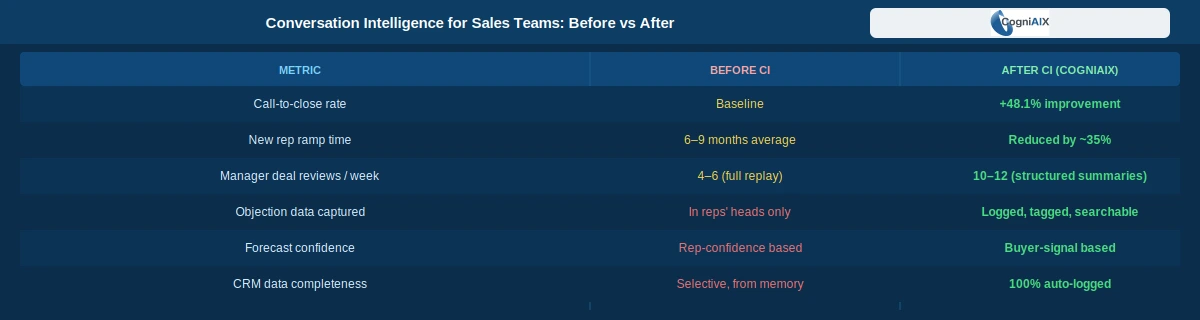
So when revenue leaders justify new tooling to finance, they need a plausible mechanism and a credible benchmark. Conversation intelligence for sales teams delivers both. Furthermore, according to IndustryResearch.biz, teams using CI platforms see a 48.1% improvement in call-to-close rates. Conversation intelligence software delivers both:
| Metric | Before CI | After CI Implementation |
|---|---|---|
| Call-to-close rate | Baseline | 48.1% improvement |
| New rep ramp time | 6–9 months avg | Reduced by approximately 35% |
| Manager deal reviews / week | 4–6 (full replay) | 10–12 (structured summaries) |
| Objection data captured | In reps' heads | Logged, tagged, searchable |
| Forecast confidence | Rep-confidence based | Buyer-signal based |
Furthermore, the call-to-close improvement shows a clear mechanism. In short, when reps know every conversation gets structured and reviewed, they prepare better. As a result, managers can review the moments that matter without full replays, and coaching gets specific. When objection patterns are visible, positioning adapts faster.
Indeed, this is not a motivation tool. Furthermore, it is the infrastructure that makes conversation intelligence for sales teams work — by changing the quality of information inside the selling process.
"The shift from rep-confidence forecasting to buyer-signal forecasting is not philosophical — it is measurable. So every deal stage becomes auditable."
Three Problems Conversation Intelligence for Sales Teams Solves at Leadership Level
Problem 01: Deal Visibility
In short, pipeline reviews built on rep memory produce forecast errors. For example, the buyer who seemed interested may have already started a competitor trial. For example, the buyer who seemed interested may have already started a competitor trial. So the deal at 80% may hinge on a budget approval nobody mentioned to the rep.
Instead, it captures buyer language — not rep interpretation. So hesitation, urgency, and competitor mentions are in the transcript. Furthermore, they are structured. And they are searchable. So pipeline reviews move from confidence-based to evidence-based.
The shift: From "the rep thinks this is closing" to "the buyer said this is moving forward."
Problem 02: Rep Coaching at Scale
Furthermore, a manager with eight reps cannot review 40-minute recordings for all of them. So what gets reviewed are the deals already in trouble — too late for coaching to change the outcome.
So sales call analysis AI solves the time problem. So managers get structured summaries in under 5 minutes — versus the 40 minutes it takes to replay a full recording. Specifically, these flag the specific moments that need attention: the objection that went unaddressed, the commitment that was vague, the competitor comparison that the rep fumbled. So coaching happens on evidence, not impressions.
Indeed, teams deploying structured call coaching reduce new rep ramp time by 35%. Indeed, at a fully loaded cost of $80,000–$150,000 per sales hire, that compression has a direct dollar value your CFO can model.
Furthermore, a rep who closes their first deal eight weeks earlier generates that revenue eight weeks sooner. So the return on structured coaching is immediate and measurable. So the return on structured coaching is immediate and measurable.
Problem 03: Competitive Intelligence from Objections
Indeed, your team hears competitor mentions every week. However, without conversation intelligence for sales teams, those mentions live in individual memory and leave with the rep who heard them.
So CogniAIX logs every competitor mention. Furthermore, it makes them searchable across the whole team. You can see:
- Which competitors come up most often, at which stage, and from which rep group
- Which language effectively neutralises each competitor
- Which objection patterns repeat across multiple deals
In short, this is product marketing intelligence. Furthermore, it is gathered from your own pipeline — no survey required.
How Does CogniAIX Fit Into the Sales Workflow?
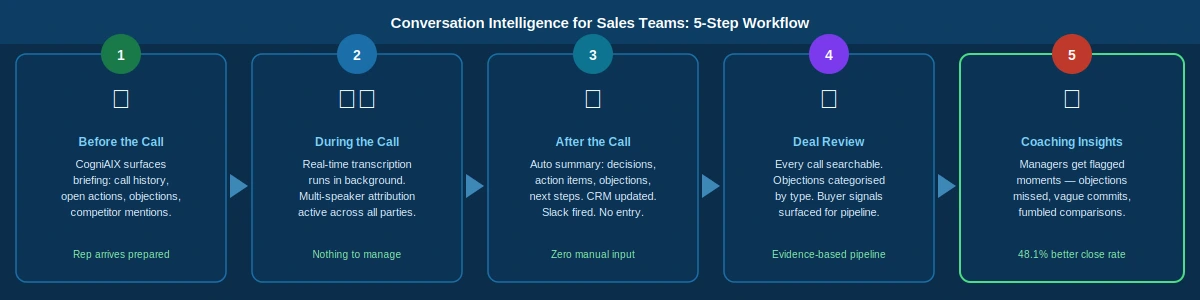
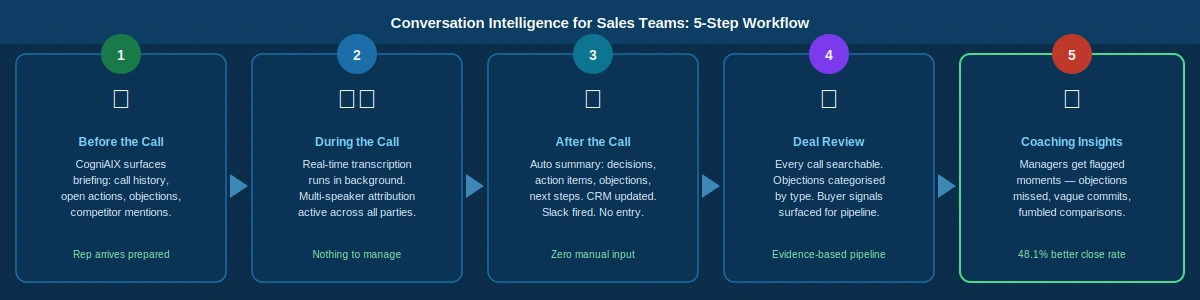
Before the Call
CogniAIX surfaces a briefing note: previous call history, open action items, objections raised last time, and competitor mentions from prior conversations. So the rep arrives prepared — no manual research required.
During the Call
Real-time transcription runs in the background. Indeed, nothing for the rep to manage. Furthermore, multi-speaker attribution is active across all people.
Immediately After the Call
Structured summary generated on its own: decisions, action items, objections raised, and next steps. So CRM record updated. Furthermore, a Slack notification fired. Also, action items in Jira. Furthermore, no manual entry.
At the Deal Review
Every call is searchable. Furthermore, objections are categorised by type and frequency. So deal signals are surfaced: prospect language, engagement trends, unresolved blockers.
How Does CogniAIX Connect to Your Existing Sales Stack?
So RevOps teams evaluating conversation intelligence software have one consistent concern: another tool that creates parallel processes instead of eliminating them. So CogniAIX connects to your existing stack without adding steps.
| Sales Tool | What CogniAIX Adds | Setup Time |
|---|---|---|
| Salesforce / HubSpot | Call summaries and buyer signals auto-attached to deal records | 3–4 min |
| Jira / Asana | Rep action items routed as tasks — nothing falls between call and follow-up | 3–4 min |
| Slack | Coaching digests and deal alerts sent in real time to managers and reps | 2 min |
| Structured summaries sent to reps before their next meeting starts | Already active | |
| Forecasting tools | Buyer-signal data added to supplement rep-entered pipeline stages | 3–4 min |
Moreover, setup does not require developer support. Furthermore, integrations are configured in minutes. So structured output lands before the end of day one.
Why Does Conversation Intelligence for Sales Teams Actually Stick?
However, the standard objection from sales leadership: reps will not use it. However, it adds friction. Indeed, they are already stretched.
It adds no workflow friction for reps because it runs passively. So the call happens. So CogniAIX captures, transcribes, extracts, and sends output. So the rep submits nothing. Reviews nothing. Furthermore, fills in nothing — unless they choose to.
In short, what reps notice first: the follow-up email is already drafted. So the work they previously did manually disappears. So adoption follows naturally when the tool reduces work rather than creates it.
Indeed, the tools that stick are the ones that give time back. So CogniAIX runs in the background. So the structured output is what surfaces — before the next meeting, not after.
When Is the Right Time to Move?
Furthermore, sales leaders who have deployed this tool consistently describe the same progression: the first month of structured call data changes how pipeline reviews run. Then by month three, the coaching cadence has shifted. Then by month six, the close rate movement is visible in the numbers.
According to IndustryResearch.biz's recent analysis, a 48.1% improvement in call-to-close rate reflects what happens when sales evidence — not sales activity — drives decisions. So this is the system that makes that shift possible.
As a result, As a result, Furthermore, So CogniAIX captures every call, structures every outcome, and connects to the stack you already run. So the trial is free. Moreover, the data is immediate. Furthermore, the ROI case builds from the first week.
People Also Ask
Why do pipeline numbers still feel unreliable even when reps update the CRM?
Because many CRM updates happen after the call and from memory. Instead, conversation intelligence captures what the buyer actually said, so your forecast is based on real signals — not guesswork reconstructed hours after the conversation ended.
How does this tool help sales leaders coach reps better?
So it shows the important moments from each call without making managers replay the full recording. So that enables clear, specific coaching on objections, next steps, and missed chances — grounded in evidence, not impressions.
Will reps actually use this kind of tool?
Yes — specifically, it runs in the background. So reps do not need to add extra work. So the tool creates the follow-up summary, updates the CRM, and sends action items on its own. So what reps notice is that the manual work disappears.
How does this help with competitive positioning?
So CogniAIX logs every competitor mention across all calls and makes them searchable by frequency, stage, and rep group. As a result, this turns scattered rep observations into structured competitive intelligence your product marketing team can actually act on.
How does this help justify ROI to leadership?
So it gives you measurable results tied to specific business outcomes: improved call-to-close rates, faster new rep ramp time, stronger forecast confidence, and reduced manager time on deal reviews. So the numbers are available from the first week of structured call data.