

Every week, your contact centre runs hundreds of calls. So most of that data sits in a recording folder that nobody opens. AI conversation analysis for customer support changes that — it reviews every call on its own, surfaces what matters, and routes findings to the teams who need them.
"The average support team reviews 2–5% of calls and calls it quality assurance. This platform reviews 100% — automatically, before anyone has to ask."
Indeed, this is not just a QA improvement. So it is a structural change in how support organisations treat and use conversation data. So it shifts calls from a cost to a resource.
Why Does Manual QA Miss Almost Everything?
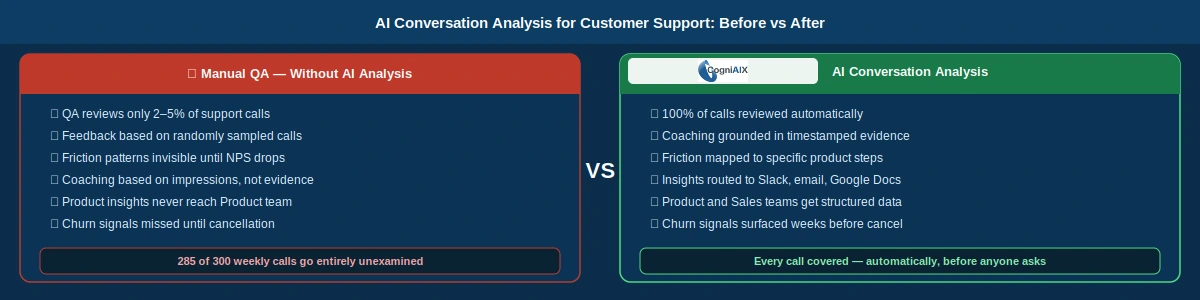
So the average QA process reviews just 2–5% of support calls. On a 300-call-per-week team, 285 go unexamined. So that is a 95% blind spot.
Furthermore, feedback is based on a handful of reviewed calls — not the patterns that define performance. So coaching is based on impressions, not evidence. Indeed, that gap is expensive.
However, the cost goes beyond missed coaching moments. According to Gartner, contact centres that increase QA coverage see a 30% faster resolution rate on recurring issues. So every unreviewed call is a missed chance to fix something that keeps coming up.
What Does AI Conversation Analysis for Customer Support Actually Do?
So AI conversation analysis for customer support is the automated processing of call audio. It flags:
- Agent behaviour patterns and empathy gaps
- Customer friction points mapped to specific product steps
- Escalation signals and unresolved commitments
- Churn indicators that surface weeks before cancellation
Furthermore, this is not transcription. However, transcription converts audio to text. So you get a wall of words. So it interprets that text. So it finds what went wrong. Then it routes structured output to where it can be acted on.
According to IndustryResearch.biz, teams using conversation intelligence platforms see a 48.1% improvement in call-to-close rates in sales. So the same structured analysis mechanism applies directly to support outcomes.
How Does AI Conversation Analysis for Customer Support Solve the Four Core CX Problems?
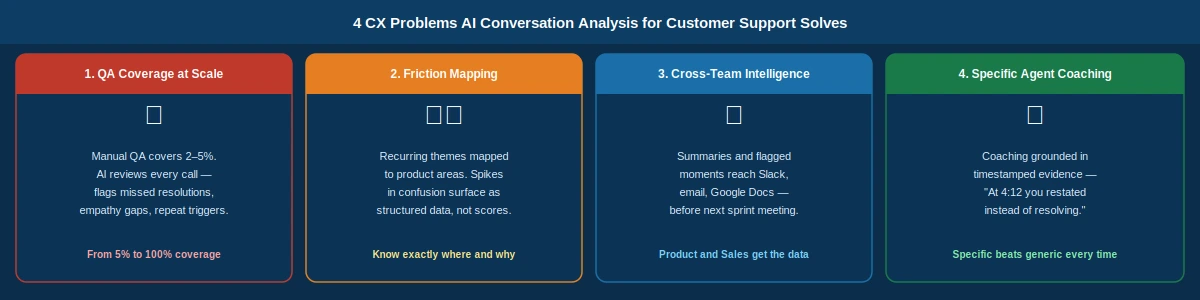
So here are the four problems it fixes, and how each one works in practice.
1. QA Coverage at Scale
Indeed, manual QA cannot cover call volume. So this tool reviews every call — not a sample. It flags:
- Missed resolution opportunities
- Empathy gaps and tone failures
- Repeat contact triggers across 100% of sessions
Furthermore, McKinsey research shows AI-based conversation analytics can reduce customer churn by up to 15% and improve first-contact resolution by 20%. So the data is clear — coverage drives outcomes.
2. Friction Mapping Across Product Areas
So when Cognia processes support calls, it identifies recurring themes. Furthermore, it maps them to specific product steps. For example, confusion around a particular step surfaces as structured data. Not a score. Instead, so you stop guessing and start fixing.
Furthermore, you do not just know customers are frustrated. So you know exactly where and why.
3. Cross-Functional Intelligence Distribution
However, insights rarely reach the teams who could act on them. So product teams hear from support via quarterly syncs. Furthermore, sales teams miss recurring objections entirely.
So with CogniAIX, summaries reach Slack, email, or Docs on their own. Furthermore, no one in support compiles or forwards anything. So every team gets what they need without asking.
4. Agent Coaching With Specificity
So coaching conversations that change behaviour are grounded in evidence. For example, "At 4:12, you restated instead of resolving" is actionable. However, "Your empathy scores could be higher" is not.
Furthermore, it gives team leads the exact moment and the exact words. So coaching is precise — not impressionistic.
What Are the Real Numbers Behind the ROI?
So when justifying this to a VP or finance stakeholder, use these three levers:
- Time recovered from manual QA: Two team leads spending 3 hours per week on manual reviews costs 300+ hours per year — at an average team lead cost of $70,000/year, that is a significant spend covering almost nothing.
- Escalation cost reduction: So an escalated interaction costs 3–4 times more than a first-contact resolution. Furthermore, AI conversation analysis identifies the patterns driving escalations before they repeat.
- Churn prevention from early signal: Indeed, support calls contain churn signals weeks before cancellation. So CogniAIX surfaces these signals 2–4 weeks earlier than traditional churn indicators.
| ROI Lever | How to Measure | Example Impact |
|---|---|---|
| QA time recovered | Hours/week on manual review × team size | 300+ hrs/year from 2 team leads |
| Escalation cost reduction | Escalation rate × cost delta × quarter | Measurable against fixed tooling cost |
| Churn prevention | Signals surfaced × intervention rate | 2–4 weeks earlier than standard indicators |
| Agent ramp time | Time to independent handling before vs after | Faster with evidence-based coaching |
| Comparison | Manual QA | CogniAIX |
|---|---|---|
| Calls reviewed per week | 6–15 (2–5%) | 100% of sessions |
| Feedback basis | Random sample | Full call history |
| Coaching evidence | Impressions | Timestamped moments |
| Insight routing | Manual email | Auto to Slack, Docs, CRM |
| Churn signal timing | Post-cancellation | 2–4 weeks before |
Why Can't CX Leave This to Sales Tools?
However, most conversation intelligence tools are built for revenue teams. So Gong and Chorus focus on sales coaching. Furthermore, they do not cover support calls or friction mapping.
So CogniAIX is built for all-team call intelligence. Indeed, over 10,000 professionals rely on it daily. Furthermore, support teams typically see QA coverage jump from 3% to 100% in their first week.
So your support calls carry revenue-critical intelligence. So AI conversation analysis for customer support is how you capture it — systematically, not by chance.
Start analysing your support calls — free trial, no credit card required.
People Also Ask
What does this platform actually do for support teams?
So it automatically processes support call audio. So it extracts structured insights — agent behaviour, friction points, escalation signals. Furthermore, every session is indexed from the moment it ends.
How does this improve agent coaching?
So it gives team leads specific, timestamped evidence. For example, the exact moment an agent restated instead of resolved. Indeed, vague feedback does not move metrics. However, specific, timed feedback does.
Can it really cover 100% of support calls?
Yes. Indeed, manual QA covers just 2–5% of calls. So CogniAIX processes every session. So live calls transcribe on their own. Furthermore, uploads in MP3 and M4A format produce identical output.
How does it identify churn risk?
So CogniAIX detects escalation patterns, frustration signals, and competitor mentions. Furthermore, these surface before they appear in churn metrics — typically 2–4 weeks earlier.
How does CogniAIX route insights to the right teams?
So summaries and coaching notes route to Slack, email, or Docs on their own. Furthermore, Product and Sales receive the intelligence without anyone in support forwarding it.