


Three tools, one budget line, completely different outcomes — here is how to tell them apart.
If you have spent time comparing AI tools for meetings and communication, you have almost certainly hit the same wall: three different products, described with nearly identical language, that do at its core different things.
So the term conversational intelligence platform is appearing in procurement shortlists, vendor pitches, and IT evaluation frameworks with striking frequency. According to IndustryResearch.biz analysis, keyword interest has grown 900% year over year — a signal that the market is expanding faster than buyer understanding of what the category actually delivers.
As a result, this matters because buying the wrong tier is a common and expensive mistake. However, a chatbot is not a conversational intelligence platform. A basic transcription tool is not one either. Instead, the differences are structural, and they determine what your team gets out of the investment.
What Are the Three Categories?
Start here before you open any vendor proposal:
| Category | Conversational AI | AI Meeting Assistant | Conversational Intelligence Platform |
|---|---|---|---|
| What it does | Generates responses in real time via chat or voice. | Joins calls and produces a transcript or summary. Does not interpret, assign, or route output. | Captures, interprets, structures, and distributes conversation output. Detects commitments and routes tasks automatically. |
| Best for | Customer-facing bots, support deflection, FAQ automation | Personal note-taking, basic transcription, simple summaries | Team-wide operations, knowledge management, productivity at scale |
"The question to ask before any vendor demo: Does this tool produce structured output I can act on — or does it produce a file I have to process myself?"
Why Does the Confusion Exist — and What Does It Cost?
All three categories involve voice or text. All three involve AI. Furthermore, all three vendors describe their products as "intelligent." That convergence of language has made genuine category comparison difficult for buyers who are not already inside the market.
Moreover, the cost is not just a wasted subscription. It is a wasted decision cycle. For example, a team that buys a meeting assistant expecting the output of a conversational intelligence platform will rebuild its shortlist in six months. Still, action items will still require manual entry. The search query from four months ago — "what did we agree with the client in March?" — will still have no answer.
Therefore, getting the category right at the evaluation stage is the decision that matters. Then everything after that is setup.
Side-by-Side: What Each Tool Actually Does
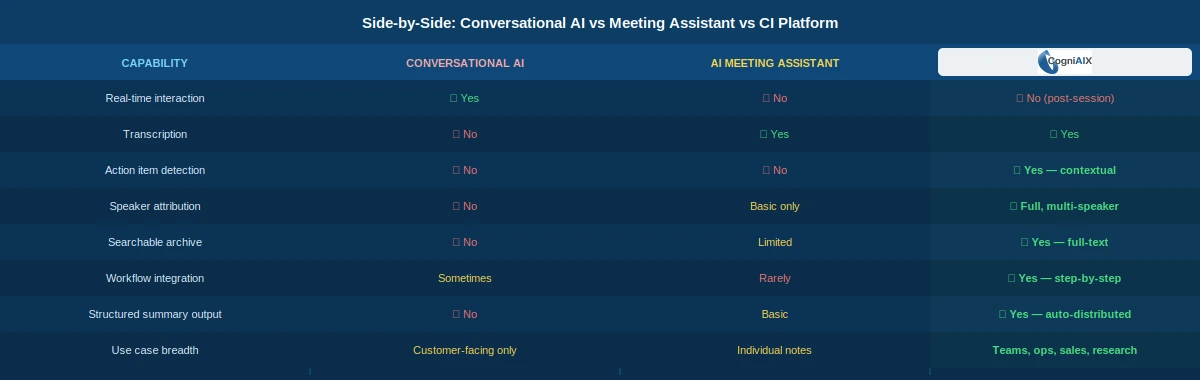
| Capability | Conversational AI | AI Meeting Assistant | Conversational Intelligence Platform |
|---|---|---|---|
| Real-time interaction | Yes | No | No (post-session) |
| Transcription | No | Yes | Yes |
| Action item detection | No | No | Yes — contextual |
| Speaker attribution | No | Basic | Full, multi-speaker |
| Searchable archive | No | Limited | Yes — full-text |
| Workflow integration | Sometimes | Rarely | Yes — step-by-step |
| Structured summary output | No | Basic | Yes — auto-distributed |
| Use case breadth | Customer-facing only | Individual notes | Teams, ops, research, sales |
What About Complexity and Adoption?
Indeed, the most consistent concern among ops evaluators and IT decision influencers is not whether a conversational intelligence platform delivers value. It is whether the organisation will actually use it.
Indeed, the concern is reasonable. in short, many tools in this category have required developer support for setup and change management to drive adoption.
However, the platforms worth evaluating in 2026 have resolved the friction problem:
- Getting started should take less than a minute
- Integration tutorials should guide setup without requiring technical expertise
- The platform should reduce workflow steps rather than add them
So if team members have to take extra manual steps, adoption will not follow. The right conversational intelligence platform disappears into the workflow. In fact, users notice the structured output — not the tool that produced it.
How Do You Justify the Investment to Leadership?
Finally, finance and leadership teams evaluating a conversational intelligence platform need two things: a credible benchmark and a clear mechanism. Both exist.
Industry research consistently shows that teams adopting conversational intelligence platforms see significant improvement in call-to-close rates and team efficiency. in short, the mechanism is consistent: when every conversation is captured, structured, and made searchable. And when action items are sent on its own — decisions improve at every level of the organisation.
also, the case is strongest when scoped to a specific workflow. Start with one team, one use case. Measure the output difference in the first 30 days. Furthermore, the data builds the internal case faster than any vendor presentation.
Where Does CogniAIX Sit in This Category?
CogniAIX is built to deliver what the conversational intelligence platform category promises. Here is what that means in practice across five pillars:
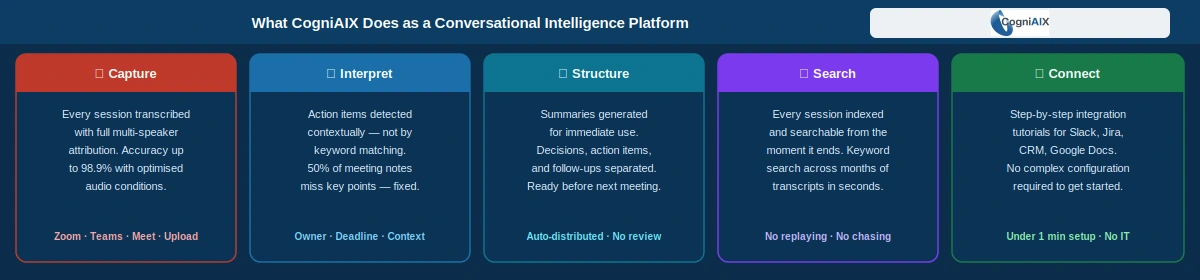
Capture — Every session is transcribed with full multi-speaker attribution. So accuracy reaches up to 98.9% with optimised audio conditions.
Interpret — also, action items are detected contextually from conversation — not by keyword matching. CogniAIX flags follow-ups so they are impossible to miss. Research shows that 50% of meeting notes miss key points; CogniAIX addresses this on its own.
Structure — Furthermore, summaries are generated in a format designed for immediate use: key decisions, action items, and follow-ups separated and ready to share — delivered before people reach their next appointment.
Search — So every session is indexed and searchable from the moment it ends. Keyword search across months of transcripts returns results in seconds — no replaying, no chasing.
Connect — Integration tutorials guide step-by-step setup to plug CogniAIX into your existing workflow. No complex setup required.

Overall, over 10,000 professionals, students, and teams rely on CogniAIX to turn conversations into progress. The free plan is available with no credit card and no training required — setup takes less than a minute.
What Teams Are Saying
"Our lab's project managers used CogniAIX to surface decisions and assign tasks before meetings ended. Conversations that previously produced whiteboard to-do lists now produced owner-assigned tasks in our tools — while the meeting was still happening. Task assignment across projects is now 50% faster." — Dr. Sophia Nguyen, Sociology Researcher
See CogniAIX in action — free demo or trial available. No credit card required.
People Also Ask
Why can't we track who agreed to what in meetings?
Because most tools only record conversations — they don't assign ownership. However, a conversational intelligence platform goes further: it detects commitments during the call and assigns clear owners, so nothing gets lost between the meeting and the follow-up.
What is the real difference between a chatbot, meeting assistant, and CI platform?
So a chatbot talks to users. A meeting assistant records and summarises. But only a conversational intelligence platform turns conversations into structured, actionable work — tasks, decisions, and follow-ups routed to where work happens.
Why does my team still rely on memory after meetings?
Because transcripts and notes are hard to use, people don't revisit them. As a result, a conversational intelligence platform makes everything searchable and structured, so you get answers instantly instead of relying on memory.
How can I justify investing in a conversation intelligence platform?
So start by looking at the time and effort lost after meetings — manual follow-ups, missed tasks, repeated discussions. A conversational intelligence platform closes these gaps and improves efficiency, delivering clear ROI within weeks.
Does a conversational intelligence platform require IT involvement to deploy?
However, with CogniAIX, no. Setup takes less than a minute — connect via authorisation to your existing meeting platforms and you are ready. Furthermore, no developer support, no IT ticket, and no training sessions are required.