
Every meeting ends with ideas, commitments, and next steps, and what is conversation intelligence if not the thing that helps those outcomes last beyond Thursday?
It does not happen because people were careless. It happens because the usual way teams capture meetings was never built to be reliable. That is why convenience is not enough. Reliability matters most. Conversation intelligence platforms solve this problem in a systematic way. Rather than relying on people taking better notes or running shorter meetings, they automate how a conversation gets captured, understood, and shared.
For businesses operating across time zones, the productivity impact of this shift is significant. A McKinsey analysis of asynchronous collaboration in distributed teams estimated that effective async communication infrastructure reduces unnecessary synchronous meeting time by 20–30% without reducing alignment quality, freeing that time for focused individual work, where most knowledge work value is created. Furthermore, IndustryResearch.biz projects a 35.43% CAGR for the CI platform market through 2034, which signals how fast teams are recognising the gap.
In this blog, we discuss what conversation intelligence is, how it works, and why a growing number of teams are treating it as essential infrastructure rather than a productivity add-on.
What Is Conversation Intelligence in Simple Terms?
A conversation intelligence platform is software that processes spoken conversations, meetings, calls, interviews, and lectures, and converts them into structured, actionable outputs: transcripts, summaries, decisions, tasks, and assigned owners.
The category is distinct from simple transcription tools in one critical way: transcription converts speech to text. Conversation intelligence (CI) converts speech to meaning, and from meaning to action.
"A transcript records what people said. Conversation intelligence records what the team decided and what happens next."
A transcription tool records the conversation. It does not act on your speech. A conversation intelligence platform, by contrast, turns that conversation into action — showing who committed to what, when it needs to happen, and where that information needs to go next.
The core distinction: Transcription asks "What was said?" Conversation intelligence asks "What needs to happen because of what was said?" — and then makes it happen.
What Does Conversation Intelligence Actually Do?
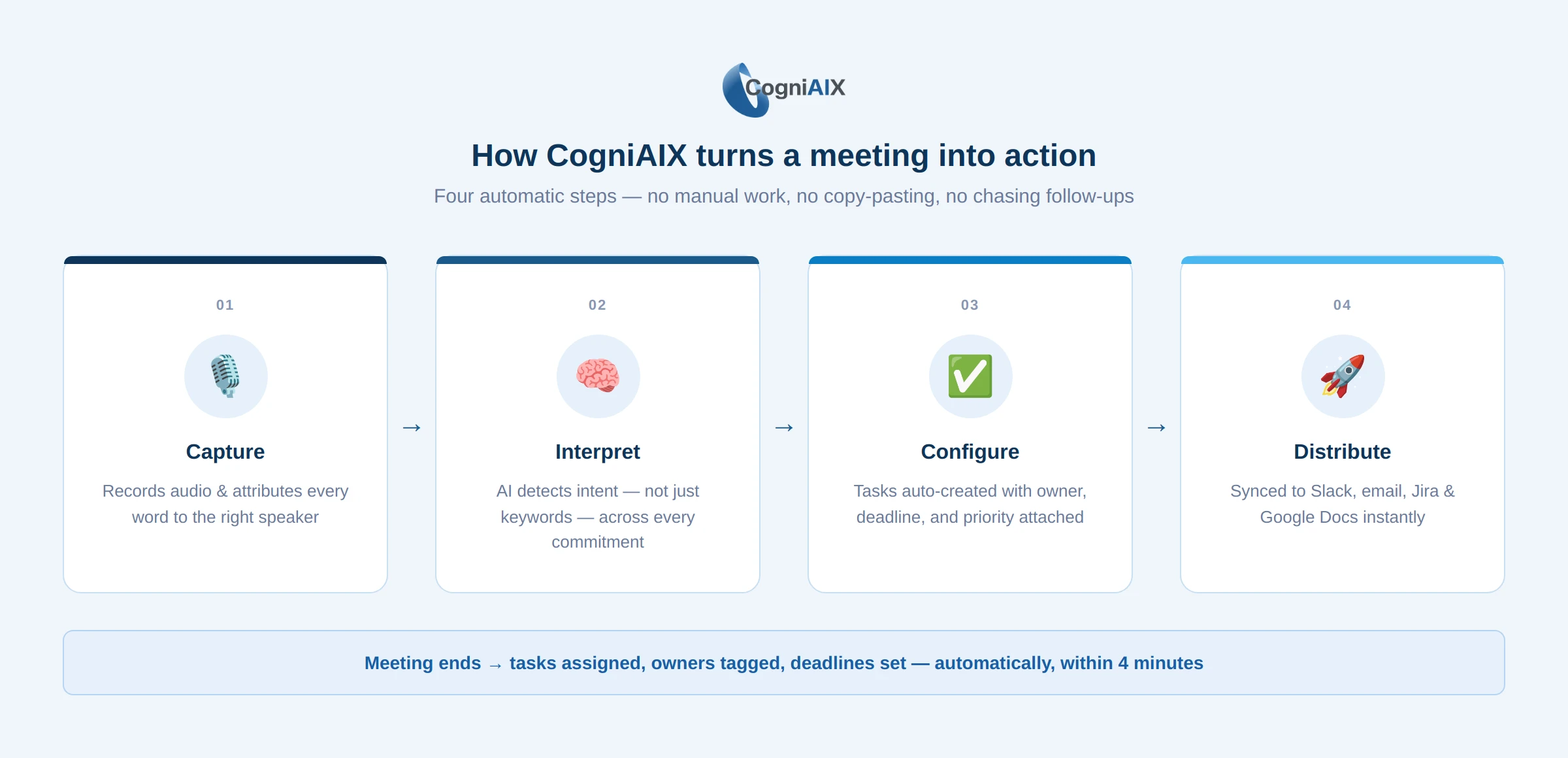
The output of a conversation intelligence platform is only as useful as the process that produced it. Here is what happens between the first word of a meeting and the moment tasks appear in your project management tool.
Step 1: Capture
The platform records or receives the meeting audio — live from an integration with your video conferencing tool, or via an uploaded file. From that audio, it produces a transcript with one essential property beyond word accuracy: speaker attribution. Every statement links back to the person who said it. That link matters because task and decision ownership depend on it.
Step 2: Interpret
The transcript then goes through a language model that understands intent, not just words. That is what sets CI platforms apart from simple keyword-based tools. Intent detection identifies what a statement is doing — whether a speaker is committing, delegating, confirming, or conditionally agreeing — regardless of the specific words they used.
Step 3: Configure
Each commitment turns into a task. An AI conversation analysis tool auto-detects action items and converts them into structured tasks, with an owner, due date, and priority, without anyone leaving the app. This step also handles task prioritisation and categorisation, linking commitments to the relevant project, workstream, or client context where possible.
Step 4: Distribute
The platform then sends those tasks and summaries to Slack, email, or Google Docs, with more integrations on the way. No manual task creation, no copying from notes. The meeting ends, and the work moves.
It also shares a short summary showing what the team decided and what each person committed to. You can send it via Slack, email, or Google Docs to everyone involved.
How Does a Conversation Intelligence Platform Differ from Basic Transcription?
This is the question most buyers get wrong at the evaluation stage. The table below shows why the gap matters.
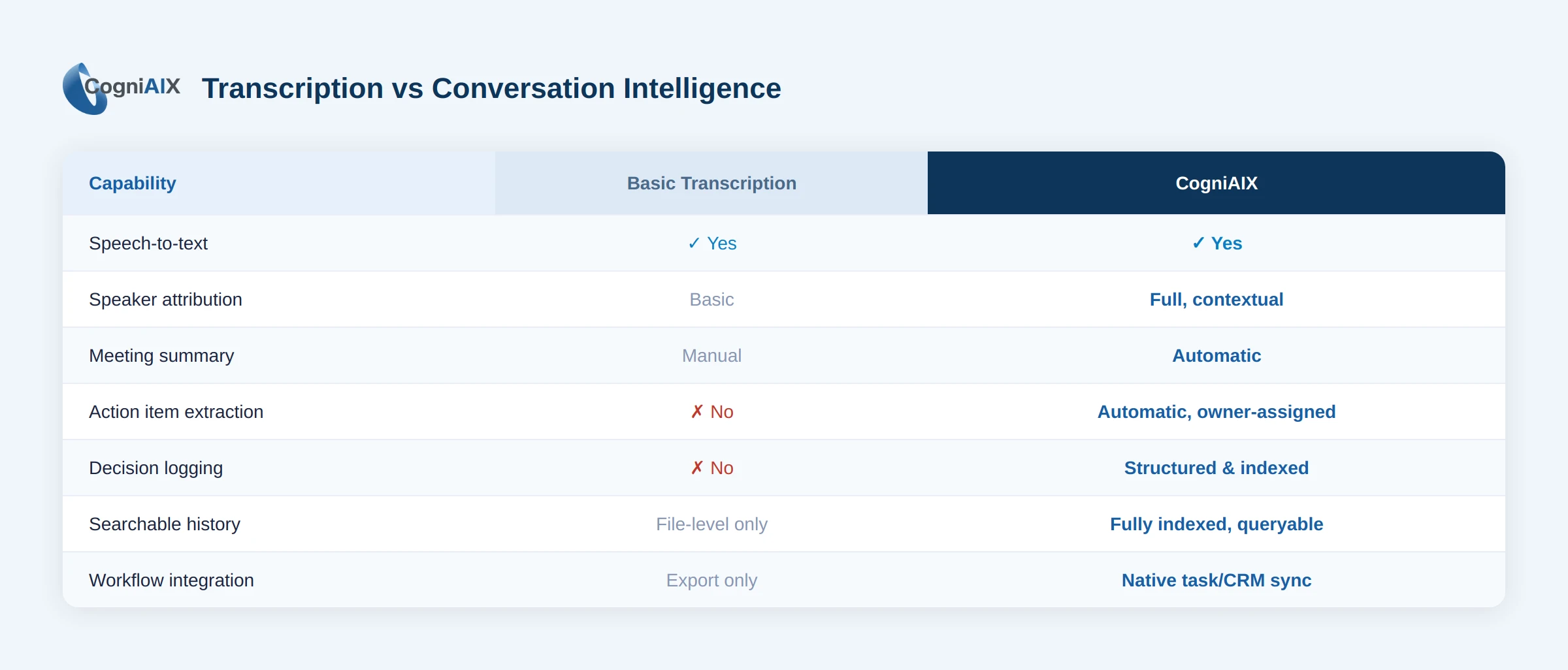
A transcription tool is the raw material. A conversation intelligence platform is what you build with it — at machine speed, across every meeting your organisation runs, without anyone having to ask.
Meet CogniAIX — The Platform Built to Close the Gap
CogniAIX is CogniAIX's flagship conversation intelligence platform. Its single purpose: turn every spoken commitment into a tracked, owned, deadline-tagged task automatically — before anyone closes their laptop.
Most tools stop at transcription. CogniAIX goes further. It reads context, extracts meaning, and helps teams move from talk to action. Unlike a note-taker, it serves as the execution layer between what your team says and what your team does.
Cognia — CogniAIX's built-in AI agent — drives every step. Cognia understands how people actually talk. It looks for intent, not just trigger words. It catches "I'll take care of that" and "Let me loop Sarah in" with the same reliability as any formally worded commitment.
Four things define how CogniAIX works:
- Radical simplicity: Completely handled in four steps — capture, interpret, configure, and distribute. No manual work, no copy-pasting, no chasing follow-ups.
- Intelligent summaries: You get decisions, not just a transcript of the chat. Tasks are spotted automatically, owners and deadlines are attached, and nothing slips through the cracks.
- Searchable Conversation Hub: Find clips and notes in seconds, across every meeting your team has ever run.
- Trust and privacy: End-to-end encryption, permanent user-controlled deletion, and a strict no-third-party-sharing policy. CogniAIX never uses your conversation data for model training.
Who Can Use CogniAIX and See Results?
CogniAIX delivers measurable outcomes across every role that runs, attends, or depends on meetings.
Team Leads and Project Managers eliminate post-meeting admin entirely. Tasks appear in Jira, correctly attributed, with deadlines, within four minutes of the meeting ending. Team leads shift from 35 minutes of note-cleanup to a 2-minute review. Accountability becomes visible, not interpersonal.
Operations Managers gain a searchable memory across every decision from every meeting — indexed, encrypted, and retrievable in seconds. The answer to "What did we decide last Tuesday?" no longer requires replaying recordings or chasing down colleagues.
Educators and Students get structured records of every key point and follow-up action without lifting a pen. Educators can share session transcripts with students, giving everyone access to the same structured notes from every class — no extra admin required.
Customer Case Study
From 4 hours of sprint admin to tasks assigned before the call ends
Fluxion's PMs spent four hours every sprint copying notes into Jira, manually assigning tasks, and chasing owners across Slack and email.
"CogniAIX moved our follow-ups from scattered chat threads to our task list automatically."
— Sai Harsha, Product Manager, Fluxion Solutions
People Also Ask
What is the difference between conversation intelligence and call recording?
Call recording captures audio for later playback. Conversation intelligence processes that audio automatically — extracting decisions, commitments, and action items so the content of the meeting becomes immediately usable without anyone reviewing the recording. Recording saves the words. Conversation intelligence acts on them.
Is conversation intelligence software only useful for sales teams?
No. The technology originated in sales, where tracking verbal commitments to prospects has direct commercial value, but the underlying problem exists in every meeting-heavy function. Teams in product, operations, research, education, and client services all deal with the same issue: meetings create talk, but work does not always follow.
Is data from meetings kept private and secure?
CogniAIX encrypts all data end-to-end, operates a strict no-third-party-sharing policy, and gives every user permanent one-tap deletion. CogniAIX never uses your conversation data for model training. Your data stays yours — always.
The Bottom Line — What Is Conversation Intelligence in Simple Terms
Conversation intelligence is not a feature; it is infrastructure that solves a structural problem. The gap between what gets said in meetings and what gets done afterward is not a discipline issue — it is a systems issue. The process most organisations use to convert verbal commitments into tracked tasks was never designed to work reliably, and it does not.
CogniAIX closes that gap systematically — capturing every commitment, identifying every owner, setting every deadline, and routing every task automatically from the first meeting forward. The teams building this infrastructure now are not just recovering lost productivity. They are building the operational foundation that makes every future meeting more valuable than the last.
See CogniAIX Turn Talk into Action — Try Free, no credit card required →
For a deeper look at how platforms compare, see our guide: Conversation Intelligence Platform vs. Basic Transcription.
External reference: McKinsey — The value of getting async collaboration right