

What Is Conversational Intelligence? A Clear Definition
Conversational intelligence is software that turns spoken talk into clear, searchable notes. It logs what was said. Moreover, it logs what was agreed, who owns each task, and what is still open. In short, it turns a call into a record your team can act on, not just a wall of text you have to read.
According to Microsoft's Work Trend Index report, the heaviest meeting users — the top 25% — spend 7.5 hours a week in meetings. Therefore, in a 50-person team, the dozen or so people carrying that load account for roughly 90 hours of talk every week on their own. However, most of those hours leave no structured record behind.
Sellers advertise 98% accuracy, and some claim 99%. However, a single score tells you little about day-to-day use. CogniAIX, for example, reports 98.9% on clear English audio, plus 92% for spotting tasks and 89% for naming owners — though those are its own tests, not outside ones.
Therefore the label gets used loosely. Two tools with the same badge can work in very different ways. Below you get the plain meaning, the 5 parts that matter, and a 4-step test you can run inside a free trial, on 1 real call.
A transcript answers what was said. Conversational intelligence answers what happens now.
What is the difference between transcription and conversational intelligence?
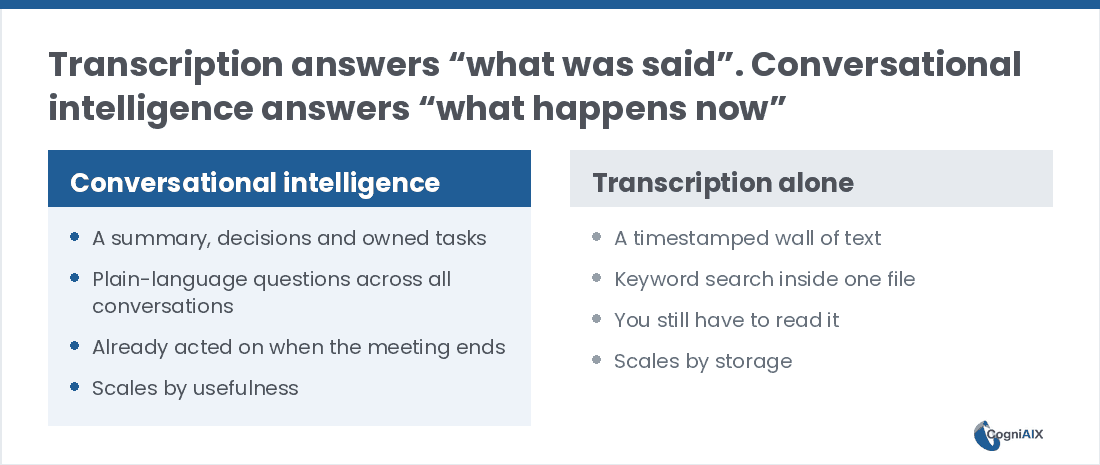
In short, a plain transcript answers "what was said." This software answers "what happens now."
First, a transcript hands you a wall of text. Conversely, a smarter tool reads that text as a colleague would. Specifically, it tells a real promise from small talk. Then it gives that promise to the person who owns it. Finally, it raises the promise again before anyone forgets.
Therefore the gap is not about quality. Rather, it is a gap in kind. Notably, most meetings do not fail because no one wrote things down. Instead, they fail because what got written down never turned into work. Then no one can find the choice 6 weeks on, when someone asks again.
The 5 parts of conversational intelligence
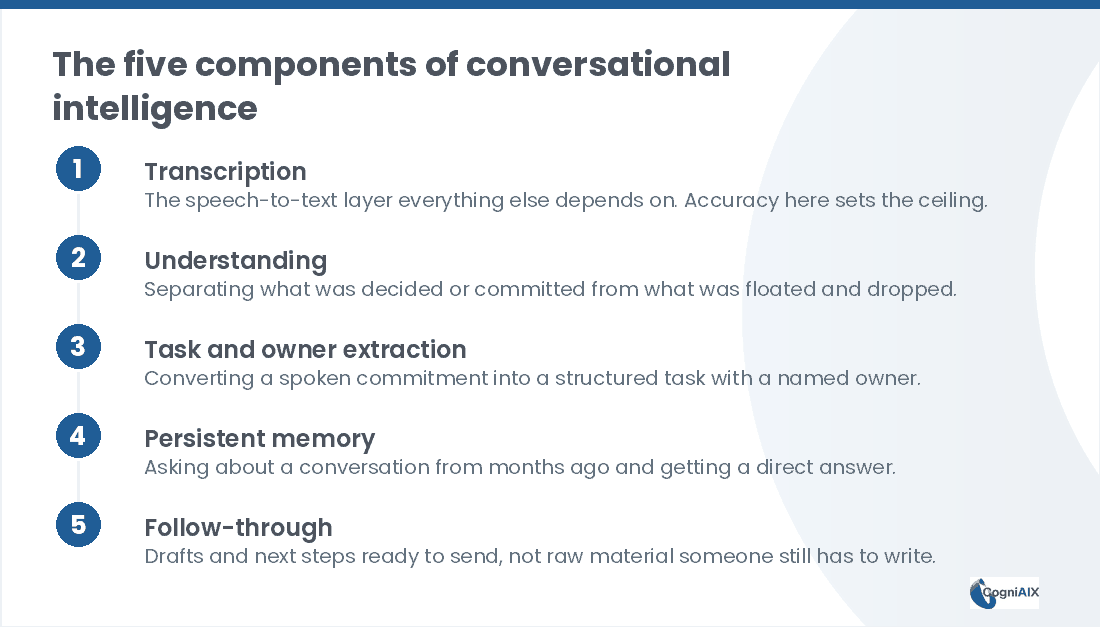
Notably, not every tool has all 5 parts. Namely, the ones they skip cost the most to build. Therefore check each one before you buy.
- Transcription — the speech-to-text layer everything else rests on. Since accuracy sets the ceiling, ask how the seller tested it. Indeed, CogniAIX claims 98.9% on clear English audio, though that is its own test.
- Sense-making — telling what was agreed from what was only floated as an idea.
- Task and owner spotting — turning a spoken promise into a task with a named owner. Admittedly, this is hard. Similarly, CogniAIX claims 92% for tasks and 89% for owners. For how task and owner spotting and follow-through work as a coordination layer across every call, not one meeting at a time, see the chief-of-staff framing.
- Lasting memory — the power to ask about a call from 90 days back and get a straight answer.
- Follow-through — drafts and next steps ready to send, not raw notes to write up.
Hence a tool that does only the first part is a transcript app with an "AI" badge. However, one that does all 5 is close to the real thing. Nonetheless, most sit in between. That is why the name alone tells you little.
Moreover, accuracy above 95% matters less than what comes next. Thus a tool at 97% that names owners well beats one at 99% that hands you a wall of text. In short, the layers on top are where the value sits.
For a walkthrough of how these 5 parts fit together, see how conversation intelligence works, end to end. This page gives the meaning. However, that page shows the mechanics.
How do you test conversational intelligence software?
First, run these 4 steps in any free trial. Importantly, each takes minutes. Then, together, they save time you would lose finding gaps after you buy.
- Record a real call with at least 4 speakers. Additionally, include a moment where two people talk at once. Add one casual promise too, such as "yeah, I'll pick that up."
- Check the recap. Does it split what was agreed from what was just aired? Consequently, if every point shows up as an equal bullet, part 2 is missing.
- Wait a week. Then ask a question without opening the call. If you must find the call first, the memory does not last, and part 4 is missing.
- Check whether follow-up was drafted. If you get raw notes to write up, part 5 is missing.
Now, step 3 tells you the most. In fact, it is the one check that sorts a real tool from a transcript with a recap bolted on.
Moreover, step 2 is where the review pass earns its keep — the five-step workflow from a recorded call to a confirmed task list sets out what that pass should actually involve.
Conversational intelligence vs conversation intelligence vs meeting intelligence
Meanwhile, people use these three terms in much the same way. In casual use that is fine. However, where a line is drawn:
| Term | What it tends to mean | Scope |
|---|---|---|
| Conversational intelligence | The running link with all a team has talked about | Every call |
| Conversation intelligence | Often used for sales-call analytics: talk ratios, objections, coaching | Sales calls |
| Meeting intelligence | The meeting-bound version: recaps and actions for one call | One meeting |
Nonetheless, no seller is bound by these labels. For third-party confirmation of how the category itself is named and scoped, G2 lists it as Conversation Intelligence Software. Ultimately, that is why a product name tells you so little.
The 1 question that settles it
Admittedly, sellers describe themselves loosely. As a result, 2 tools with the same badge can differ a lot. Specifically, do they name owners right? Then, does the memory last? Does follow-up get written for you?
Therefore ask one question: what happens to a spoken promise from a call 3 months ago?
If the honest answer is "you would have to find that call and search the text," you have a transcript with a recap layer. However, if the answer is "ask, and you get a straight answer with the context," you have the fuller version.
Accuracy above 95% matters less than whether the tool names the right owner.
How CogniAIX frames conversational intelligence
Therefore CogniAIX is built around the fuller idea, not the transcribe-and-recap version. Moreover, every call joins one lasting searchable memory, whether it is live or a file you upload.
In turn, Cognia, the AI layer, does more than sum up a call. Thus it spots promises, names owners, and drafts the follow-up. Also, it answers plain questions about all it has heard. Since it can automate the write-up, teams save time and reduce effort they once spent piecing together what was agreed.
Related: why decisions get forgotten even when written down.
People Also Ask — Conversational Intelligence
Is conversational intelligence the same as conversation intelligence?
Most buyers and sellers use the two terms in much the same way. However, where a line is drawn, "conversation intelligence" tends to mean sales-call analytics, such as talk ratios and objection tracking. Meanwhile, the wider term covers the job of turning any spoken call into clear, useful, searchable notes.
Do I need conversational intelligence, or is a transcript enough?
Firstly, if you just need a written record to check now and then, a transcript may be enough. However, if you lose track of who owns what, re-open settled choices, or spend real time each week piecing together what happened, that is the gap this software closes.
Does conversational intelligence need a bot in every call?
Not always. Granted, a visible bot is common. Still, some tools, CogniAIX among them, take both live capture and uploaded files. Therefore a call caught elsewhere joins the same searchable memory.
Which of the 5 parts matters most?
Lasting memory, for most teams. Now, transcripts and recaps are the oldest parts and the easiest to get right. However, memory across calls is the hardest to build. Ultimately, it decides whether you still use the tool in 6 months.
What does conversational intelligence software cost?
Broadly, pricing splits two ways. Otter, for one, lists $16.99 per user each month, or about $8.33 on annual billing. Fireflies lists $18.00 monthly, or $10.00 annually. However, others charge per minute of talk. Since the two models scale in a different way, test both against your real call load first.
Applying Conversational Intelligence to Your Own Calls
CogniAIX captures every meeting, detects promises in context, and writes structured recaps before the next session. Moreover, it builds an encrypted, searchable archive of every call. As a result, the meeting ends and the output is already structured and indexed.
Try CogniAIX free — capture your first call today. No credit card required, and your first structured recap lands in minutes.