

Imagine it is 3:47 PM on a Tuesday. You just finished a 90-minute strategy call. Eleven people were on it. The energy was good. The agenda was full. But 20 minutes later, you cannot remember who owns the pricing review. You do not know if the Q3 launch was pushed. You are not sure if the ops update was a decision or just a suggestion.
So that is where conversation data analytics starts to matter. Specifically, it helps teams see what was decided. Also, it shows who owns what. And it makes clear what needs to happen next.
So you are not losing your mind. Indeed, you are feeling the real cost of an unstructured meeting. And it is much higher than the hour you spent in the room.
What Is the Actual Cost of Unproductive Meetings?
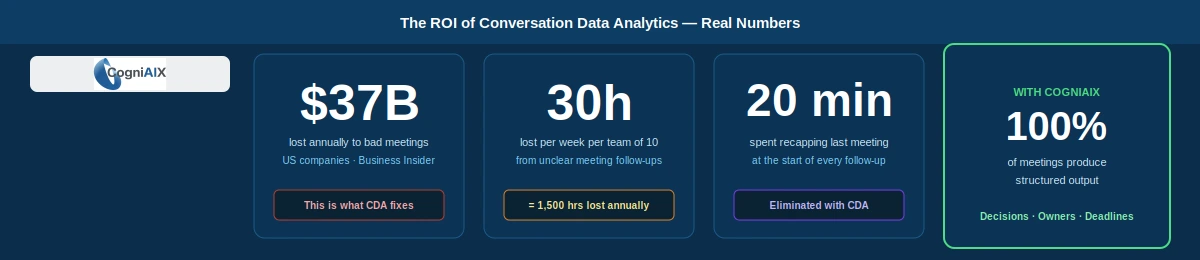
Here is a number that should stop you: according to Business Insider analysis, US companies lose an estimated $37 billion every year to wasted meetings. But that number only covers time spent in the room.
Furthermore, it does not count the follow-up emails that never get sent. Furthermore, it does not count the decisions argued over again two weeks later. Furthermore, it does not count the action items that quietly expire because no one owns them.
This is where conversation data analytics becomes a business-critical capability — not a nice-to-have. Without conversation data analytics, every meeting is essentially a black box: value goes in, noise comes out, and ownership evaporates somewhere in between.
For example, think about the last cross-functional meeting you ran. Indeed, someone probably captured notes. But were those notes shared? Were they re-read? Did the right person remember their task by Thursday?
So probably not — and you already knew that.
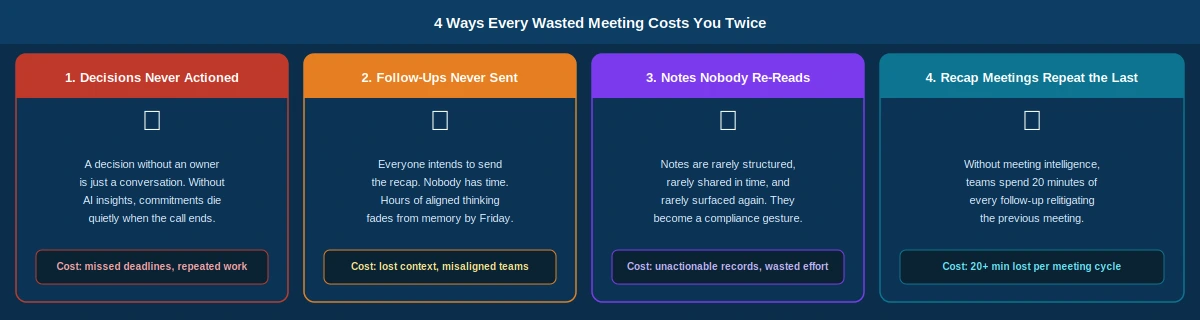
The Four Ways Every Wasted Meeting Costs You Twice
Indeed, bad meetings do not just burn time. They create downstream failure at four distinct points:
1. Decisions Made but Never Actioned
So a decision without an owner is just a conversation. So when AI insights are absent, commitments die quietly when the call ends.
2. Follow-Up Emails That Never Get Sent
However, everyone intends to send the recap. Nobody has time. The meeting's output sits in someone's memory. So by Friday, it is gone.
3. Meeting Notes Nobody Re-Reads
Furthermore, even when notes exist, they are rarely structured, rarely shared in time, and rarely surfaced again. So they become a compliance gesture. So not an operational tool.
4. Time Wasted Recapping What Was Decided
As a result, without meeting intelligence software doing the heavy lifting, teams spend the first 20 minutes of every follow-up meeting repeating the last one. Indeed, that is not alignment. That is expensive inefficiency on a loop.
As a result, each of these failure modes has a measurable cost in hours, in missed deadlines, in the compounding drag of misalignment on your team's output. So conversation data analytics is how you stop paying that cost.
| Failure Mode | Without Conversation Data Analytics | With CogniAIX |
|---|---|---|
| Decision made, no owner | Commitment dies when the call ends | Owner named, decision archived, searchable instantly |
| Follow-up never sent | Aligned thinking fades by Friday | Summary sent on its own before the next meeting |
| Notes nobody re-reads | Unstructured records sit in folders | Full-text indexed — any decision found in seconds |
| Recap meetings repeat the last | 20 minutes lost relitigating old ground | Previous decisions searchable — no recap needed |
What Does Meeting Intelligence Software Actually Change?
However, most tools stop at transcription. You get a wall of text and a rough summary. However, the same problem remains. So someone still has to read it, interpret it, and turn it into work.
Instead, CogniAIX is built differently. It is a conversation intelligence platform that does not passively record. It actively surfaces tasks, decisions, owners, and deadlines from every meeting. Furthermore, it does this on its own. So the moment your session ends, the structured output is already waiting.
CogniAIX's AI agent is trained on how people actually talk. Indeed, not just what they say. So the platform applies AI insights from conversations to extract meaning. Also, it assigns ownership. And it distributes follow-ups before anyone reaches their next appointment.
in short, that is the gap most operations leaders have been staring at for years: the space between what the team said and what the team did. CogniAIX closes it.
Is the ROI Real?
So consider a team of 10 people, each attending 8 meetings per week. If even three of those meetings have unclear follow-ups, that is 30 hours per week of lost capacity. Annualised, that is more than 1,500 hours of senior talent producing nothing. So the meeting structure failed them.
So conversation data analytics converts that waste into a visible, addressable problem. As a result, when every meeting produces structured output on its own — task lists, decision logs, assigned owners, sent summaries — the cost of poor meetings shrinks from an invisible drain to a solved operational problem.
Moreover,
CogniAIX users do not just save time. Instead, they regain the execution momentum that poor meeting hygiene quietly steals from them every week.
How Does Conversation Data Analytics Differ from a Standard Meeting Summary?
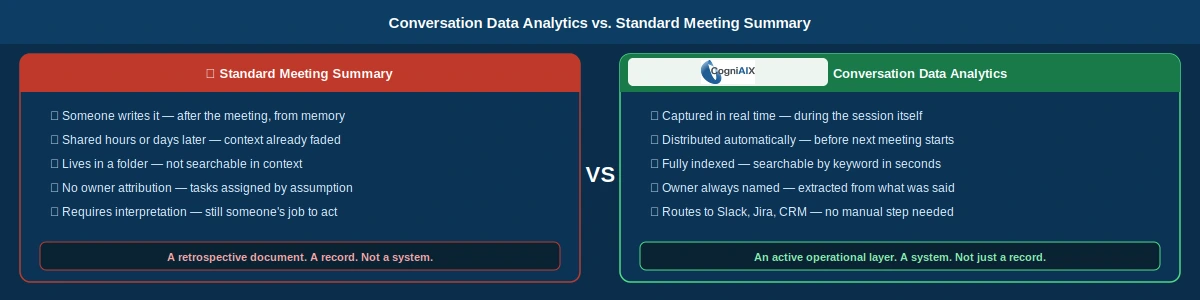
In short, a standard meeting summary is a retrospective document. So someone writes it. Then they share it. And it lives in a folder. Conversation data analytics, however, is an active operational layer:
- in short, it identifies every decision point and captures it with context, not just keywords
- also, it maps action items to named owners based on what was said — not what was typed
- Furthermore, it distributes structured output to the tools your team already uses, before the next meeting starts
- Finally, it makes every past session searchable in full text — so "what did we decide in the March review?" takes seconds, not twenty minutes
So in short, the difference is between a record and a system.
| Metric | Without Conversation Data Analytics | With CogniAIX |
|---|---|---|
| Post-meeting admin | 30–60 min per meeting | Near zero — sent on its own |
| Action item clarity | Assumed, often missed | Owner and deadline from the call |
| Decision retrieval | Inbox search and replay | Full-text search in seconds |
| Senior capacity lost | 1,500+ hrs/year (team of 10) | Recovered and put back to work |
| Tool data completeness | Manual and selective | 100% logged on its own |
| Feature | Standard Meeting Summary | Conversation Data Analytics |
|---|---|---|
| When created | After the meeting, from memory | In real time, during the session |
| When shared | Hours or days later | Before the next meeting starts |
| Searchable | No — buried in a folder | Yes — full-text, instant retrieval |
| Owner attribution | Assumed or missing | Extracted from what was said |
| Routed to tools | Manual copy-paste | Yes — Slack, Jira, CRM on its own |
| Output type | A retrospective record | An active operational layer |
What Does This Mean for Ops Leaders?
Finally, if you are a COO or operations leader, you already track use, throughput, and output. But most teams have no system for what happens inside a meeting. There is no conversation data analytics layer. Furthermore, there is no connection between the input — time and people — and the output: decisions and actions.
Indeed, that is a gap in your operations model. Indeed, it is not just a productivity inconvenience. So meeting intelligence software gives you the same rigour you apply elsewhere. So it is now applied to where most strategic decisions actually happen.
As a result, every week without it is a week wasted. So your most expensive resource — senior team time — produces outputs nobody captures. Furthermore, nobody acts on them. So nobody can prove they existed.
"CogniAIX captures the notes, highlights what matters, and surfaces follow-up tasks. We've cut costs on manual notetaking entirely." — M. Anusha, Marketing Manager, CloudBridge
People Also Ask
What is conversation data analytics?
Conversation data analytics captures, structures, and analyses spoken content from meetings. So it converts unstructured dialogue into decisions, action items, and searchable records. Furthermore, it does this on its own — no manual note-taking needed.
How does conversation data analytics differ from transcription?
However, transcription converts audio to text. Conversation data analytics goes further. So it interprets that text. Specifically, it finds what was decided. Also, it names who is responsible. Furthermore, it spots deadlines. Then it routes the output to where work happens.
What does a bad meeting actually cost?
Furthermore, beyond the time in the room, a single unstructured meeting costs 30–60 minutes of follow-up admin. Also, it costs hours of misalignment downstream. And it costs whatever missed deadlines result. For a team of 10, that adds up to 1,500+ hours of lost capacity every year.
How does CogniAIX apply conversation data analytics?
CogniAIX processes every session — live or uploaded — through its AI agent. So it identifies decisions. Then it extracts action items with owner attribution. So it structures the output into summaries. These go via Slack, email, or your CRM before the next meeting starts.
Does conversation data analytics work for recorded meetings as well as live ones?
Yes. Additionally, CogniAIX processes live meetings via Zoom, Google Meet, or Teams. Additionally, it handles uploaded recordings in MP3 or M4A format. So output quality is the same regardless of source.